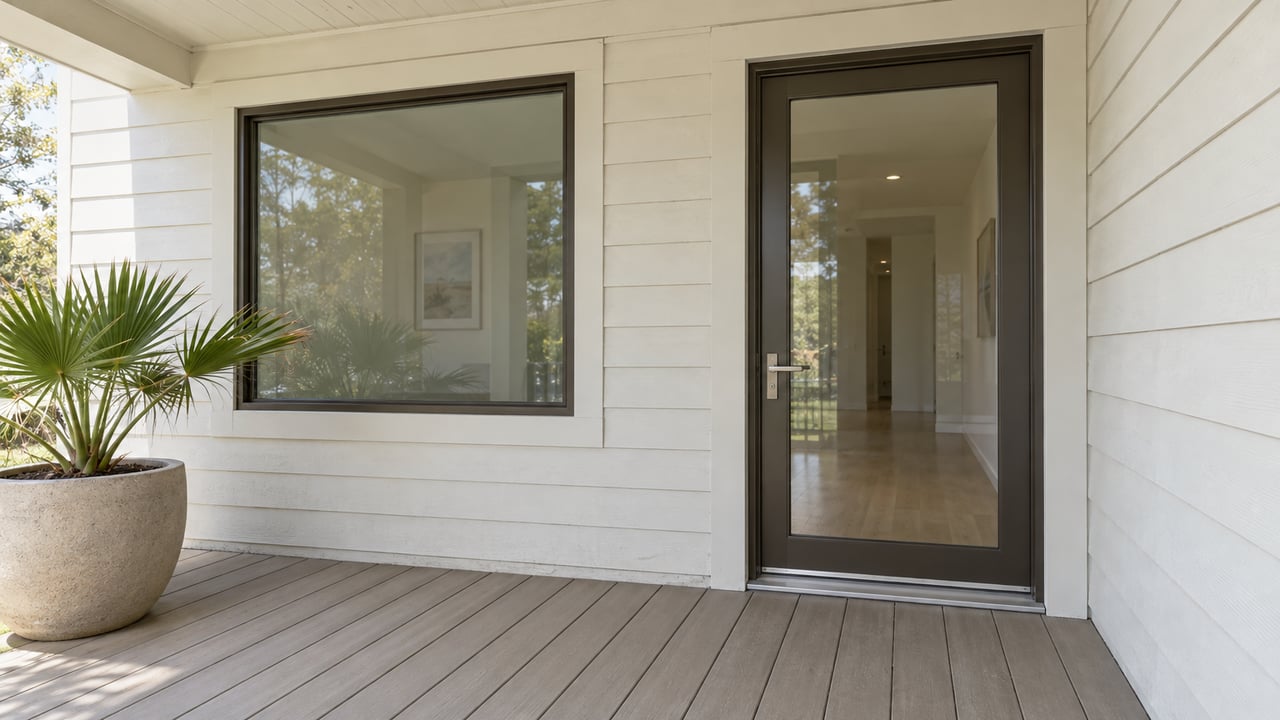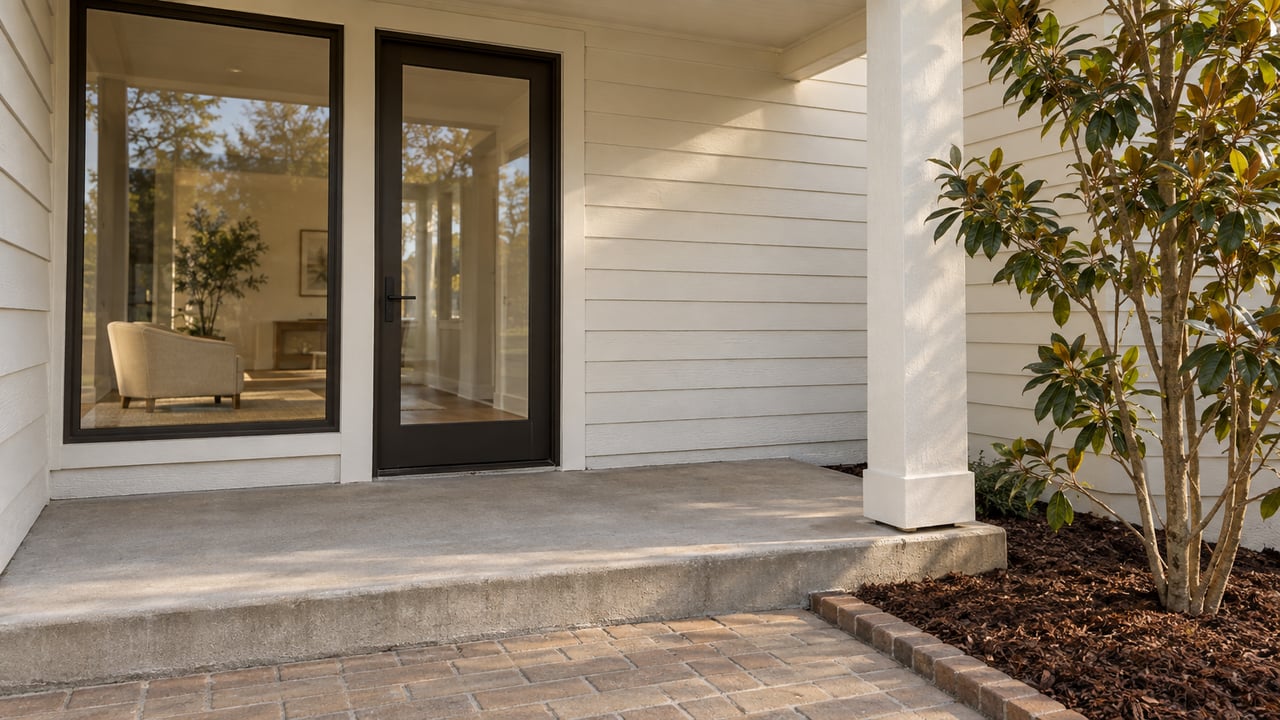
Every serious buyer looking at Wilmington's older luxury inventory eventually walks up to a house with smooth, seamless cream walls, elegant reveals around the windows, and the unmistakable look of Mediterranean stucco. Some of those homes are clad in real cement stucco. A meaningful share, especially in the premium subdivisions built between the mid-1980s and late 1990s, are clad in something else entirely, and that something else has a specific and locally famous transaction history you need to price into your offer before you sign one.
The short version: Wilmington is where the national synthetic stucco crisis began, the disclosure rules around it are stricter than most buyers realize, and the inspection you need is not the inspection your general home inspector performs by default. Handled well, an EIFS home can still be a strong buy. Handled the way most buyers handle it, the due diligence period ends with either a surprise repair number or a walked deal.
The 1995 story that still governs your 2026 offer
In August 1995, J. Allen Golden, then assistant director of the New Hanover County building inspectors office, began responding to homeowner complaints after Hurricanes Bertha and Fran soaked the coast in quick succession. He inspected 31 homes clad in what most owners believed was stucco. He found excessive moisture in all but two; several had substantial rot. Follow-up work by a Wilmington task force expanded the sample. Moisture problems were found in 98 percent of 300 EIFS-sided houses inspected in Wilmington, Charlotte, Greensboro, Raleigh, Fayetteville and on the Outer Banks.
The product is Exterior Insulation and Finish System, or EIFS. The house was actually wrapped in a proprietary lightweight synthetic cladding known as an Exterior Insulation and Finishing System, a multilayered wall system with thermal insulation built right in. The American energy crises of the 1970s propelled more architects and developers to spec EIFS because it mimicked the look of stucco while providing continuous insulation. On paper, elegant. In practice, on wood-framed Wilmington homes without back-wrapped openings and kickout flashings, water got behind the finish, could not escape, and rotted the sheathing from the inside out.
The litigation that followed originated here. The New Hanover County Business Court's 1999 opinion in Ruff v. Parex opens by describing a class certified in September 1996 involving the claims of thousands of North Carolina homeowners whose residences were constructed with a particular type of stucco exterior cladding referred to generally as Exterior Insulation Finish Systems ("EIFS") or synthetic stucco. That case, and the wave that followed it, is why every insurance underwriter, appraiser, and inspector in this market treats EIFS as its own category.
What is actually on the wall
Before you can price the risk, you have to identify what you are looking at. Three categories matter:
Barrier EIFS. The product at the center of the 1990s crisis. Foam board glued to sheathing, finished with a thin acrylic coat. EIFS are also known as synthetic stucco. EIFS was meant to be a barrier system, meaning it was not intended for water to get behind the finish. Once water got behind the finish, the moisture was trapped, causing wood rot at the wood framing and sheathing of the home, as well as creating mold and mildew. This is what most 1985–2000 Wilmington homes have if they read as "stucco."
Drainable EIFS. The redesigned system that added a drainage plane behind the foam. In 2009, the International Code Council added drainable EIFS to the international commercial and residential building codes as acceptable for use. Newer construction may use it. Insurers do not always distinguish it from the older barrier version.
Real hardcoat stucco. Cement based, no foam, rigid to the touch.
The field test is straightforward. Knock on the siding. Real stucco is completely rigid and has no "give" to it, while synthetic stucco yields slightly and tends to produce a hollow sound when knocked on. The most foolproof way is to break into a spot on the siding. A layer of foam board indicates EIFS. Do not perform the destructive test on a home you do not own. The knock test is enough to know whether to order the right inspection.
The inspection your general inspector will not do
A standard North Carolina home inspection is a visual examination. On an EIFS home, that is not sufficient. The inspection protocol developed after 1995 requires probe moisture readings taken through the cladding at every high-risk penetration.
The Wilmington market essentially wrote the national standard. As one Texas EIFS inspector puts it in describing accepted practice, the nationally accepted protocols are set forth by the EIFS Review Committee of the New Hanover County Inspection Department of Wilmington, NC, and the Georgia Association of Home Inspectors. Both protocols specify the use of probe moisture meters as an integral and crucial part of the inspection process.
When you engage a qualified EIFS inspector, expect them to probe:
- Every window and door head, sill, and jamb
- Roof-to-wall transitions and kickout flashing locations
- Chimney terminations and dormer sidewalls
- Deck ledger and rail attachments
- Hose bibs, exterior outlets, and any wall penetration
- The base of every wall where cladding meets grade
The failure modes are consistent and known. Field investigations after the initial Wilmington crisis found that the builder and installing stucco companies failed to install proper window, door and kickout flashings, back-wrap at openings, leaving leaking window and door frames. In addition, it was discovered that the foam behind the stucco, when installed at or below grade, was conductive to termite and fire ant infestation. The stucco and foam board at the ground level also created a wicking condition when wet. If your inspector is not looking specifically at those details with a probe meter, you have not had an EIFS inspection.
The disclosure question sellers get wrong
Here is where Wilmington transactions diverge from most out-of-state buyers' expectations. North Carolina requires sellers of one-to-four unit residential property to deliver the Residential Property and Owners' Association Disclosure Statement produced by the North Carolina Real Estate Commission, pursuant to G.S. 47E. Sellers can answer Yes, No, or No Representation to each item.
Some sellers of EIFS homes elect No Representation and assume that ends the conversation. It does not. The North Carolina Association of REALTORS® has published clear guidance on this exact scenario:
The presence of a product known as "exterior insulating and finishing system" (EIFS), which is often referred to as "synthetic stucco," is a material fact. As with all material facts, real estate licensees have a duty to disclose such information to prospective purchasers, irrespective of whether the seller chooses to make a representation on the N. C Residential Property and Owners' Association Disclosure Statement. Note that if a house was previously clad (either in whole or in part) in synthetic stucco, that is also a material fact which real estate licensees must disclose to prospective purchasers.
Two practical consequences for a buyer. First, if the listing agent is aware of current or prior EIFS cladding, they must tell you, even if the seller marked No Representation. If that disclosure did not happen and the cladding is EIFS, you have a documented professional-conduct issue and a stronger position at the negotiation table. Second, "previously clad" counts. A home that was re-sided in fiber cement over the same wood sheathing that spent fifteen years trapping moisture behind barrier EIFS is still a home with a history. Ask for it in writing.
Pricing the risk into your offer
Assume you have identified an EIFS home you want, run the correct probe inspection, and received the report. What now?
There are three separate financial variables to negotiate, not one.
Repair scope. Discrete failures at flashings can often be corrected without full cladding removal. Widespread elevated moisture readings, visible substrate damage, or grade contact typically require substantial removal, resheathing, and reinstallation of a properly detailed system. Your inspector's report should distinguish the two clearly.
Insurance friction. Coverage is not a given. As one attorney group summarizing the market observes, in cases where insurers have limited their exposure with EIFS exclusions or refusal to insure EIFS homes, homeowners might be forced to bear the costs of home inspections and repairs. And if insurance becomes less attainable for EIFS, affected homes will continue to lose value. Insurers don't always differentiate between older "barrier" EIFS and newer "drainable" EIFS. Get a bindable quote in hand during due diligence, not after.
Value diminution. Even after repairs, the market has historically discounted homes with EIFS history. Industry commentary on the litigation era put diminution of home value often as high as 20 to 35 percent when problems were documented. Actual discounts in today's Wilmington market vary widely with cladding condition, remediation quality, and comparable sales, but the number is a useful upper bound when you are stress-testing an offer.
A construction-literate advisor can convert those three variables into a specific counter. A buyer who treats them as a single vague concern usually leaves money on the table or overpays for the wrong house.
FAQ
Is every stucco-looking home in Landfall or Wrightsville an EIFS home? No. Both cement hardcoat stucco and EIFS were used in premium Wilmington construction from the 1980s onward, and some homes have been re-sided since. The only reliable way to know is a targeted inspection.
Does a clean EIFS inspection mean the home is a safe buy? It means moisture levels at the tested locations were within acceptable ranges on the day of the inspection. Annual re-inspection is standard practice for owned EIFS homes. Bake that ongoing cost into your holding math.
Can I get an EIFS-clad home insured in coastal North Carolina? Sometimes yes at standard terms, sometimes yes with exclusions, sometimes only through non-standard markets. Underwriting varies by carrier, cladding generation, and inspection documentation. Secure a written quote before your due diligence period closes.
If the seller marked "No Representation" on the disclosure, do I still have recourse if EIFS is later confirmed? Your recourse depends on what the seller and the licensees involved actually knew. The NC REALTORS® position is that licensees have an independent duty to disclose EIFS as a material fact regardless of the seller's election. This is a question for a North Carolina real estate attorney, not for a blog post.
If you are evaluating a premium coastal home in Wilmington, Landfall, or the surrounding Brunswick and New Hanover markets and want a construction-literate read on the cladding, the disclosures, and the offer strategy before you write the contract, Crystal Austin works with buyers privately at that level. Schedule a private consultation to review the property, the inspection scope, and the risk-adjusted offer together.